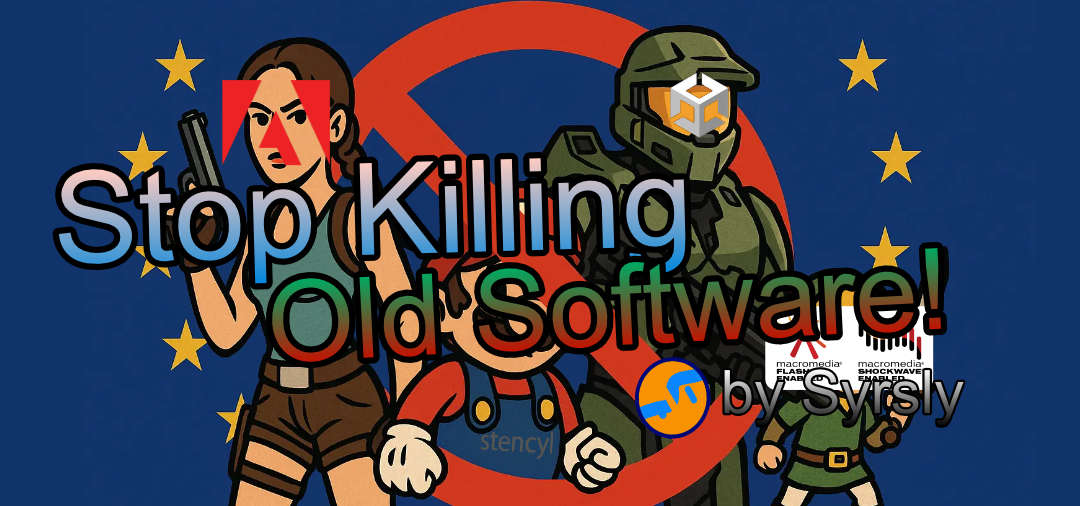
There was recently a movement to "Stop Killing Games", and I'd like us to consider expanding that movement to software. Let's stop killing software in general! Adobe is guilty of killing Flash Player, but thankfully, we had enough open source tech out there to replace it and keep the old content alive with less officially supported alternative players like Ruffle. Then, there's Unity and their web player plugin, which seemed like it would replace Flash Player as a 3D alternative before Unity pulled the plug on that plugin and we started working on WebGL alternatives which only recently reached a similar feature set to the Unity web player. I personally feel that the web player should have been open-sourced as part of a community outreach project, but Unity, like Adobe, is very anti-consumer. I'll come back to that later.
One thing I'm
definitely a nerd about is the history of the internet. However, it's
not because I want to ace trivia questions somewhere about the first
dialup modem (History-Computer)
or that time we created the internet. No, my reasons are more
self-serving: I just loved the internet "back in the day" and feel that
we've lost something special. It was more fun to explore the internet
before it became this mostly corporate social media world. There's still
stuff out there like what I once explored, but the culture of the
internet as a whole has moved away from that stuff to become bland and
mostly uninteresting with an odd fixation on extremely short blog posts
on only a spare few blog hosting sites we now refer to as social media.
I grew up with some wild stuff like Flash and Shockwave, but before even those, we had HyperCard. (Ars) What was cool about HyperCard was it made things interactive and fun
to look at long before we even had Flash Player. It wasn't really an internet thing,
but it was an early attempt at what Macromedia Flash would eventually
become... sort of. The HyperCard technology was able to handle a lot of
stuff but wasn't web-centric, while Flash was more animation-focused and
required some additional overhead to accomplish a similar goal. It was
still a great step forward for animators at the time, and it was great
for making... flashy... webpages, too... before we even had ajax
requests in 1999. (IE5 Wiki)
Anyway,
it feels like we keep killing technology that was simple to use in
favor of technology that over-complicates the same deliverables we
already accomplished. I wish we could just fix problems with the old
stuff rather than throw it in the trash and start new every few years.
I'm looking at you, Unity game engine! *Ahem!*
Like Adobe, Unity jumped ship from the product business to the service business decades ago, and like many others, I was a customer they abandoned soon after that switch. Like Adobe, Unity made it increasingly harder over time to use their old software and eventually made it impossible to activate an old license you legitimately bought. The only way to use Unity 4.x now is to use a pirated, cracked copy of it, which introduces security challenges and performance hits due to those security challenges. For example, you have to run the cracked copy in a sandboxed virtual machine to reduce the likelihood of a virus taking over the system or the app from calling home, and any compiled code is at high risk of being infected by extension. Similarly, Adobe removed old licenses for Flash years after CC was a thing because it would force us old users to buy the new subscription or download a crack to keep using their software even though the software was sold to us as a product, not as a subscription. All of this is anti-consumer, but it's also anti-progress, because it means they don't actually have to improve their software to get old users to upgrade; They just have to make old versions no longer work when the time comes to force their customers to upgrade.
The workaround for now is to stop supporting closed source software whenever possible. Open source software doesn't typically get killed as easily, because even if the original developer stops working on the project, if enough people are passionate about the project, they will create a fork of the project and keep it alive. This is what happened with Atom Editor: We got Pulsar Edit. Rarely do we get closed source projects open-sourced after their life ends, but we do sometimes have that happen, and it's nice when that finally happens. For example, Tilt Brush became Open Brush and the open source community managed to expand Tilt Brush to have multiplayer and fix tons of bugs and have integration with Liv's mixed reality app within weeks. We also get a lot of hybrids of open source projects and closed source tools, like Stencyl's editor being closed source but their actual game engine being MIT-licensed. I like this because we get the engine as a starting point to keep old games working if the company ever goes under or gets sold to someone else. The editor is where the meat of the project is, mind you, but at least we can easily preserve old projects and have a ground truth of how the game engine operates. It feels safer than other tools like Unity where the entire engine is closed source. Unreal, Unity's biggest competition, is now partially open source as well.
If you're looking for a modern Flash alternative that kind of doubles as a modernized HyperCard (depending on how you use it), look at Wick Editor. It's open source (GPL
3) and works incredibly well. I highly recommend it if you want to
bring life to the web or make a modernized version of a Flash game.
Alternatively, if you want to add CSS animations to your webpages, try
my CSS Animator instead, but it's more geared toward simple object manipulation tasks I find obnoxious without said tool. If your goal is 3D game creation, look at Godot.